
Why Sciatica Doesn’t Always Start in Your Back
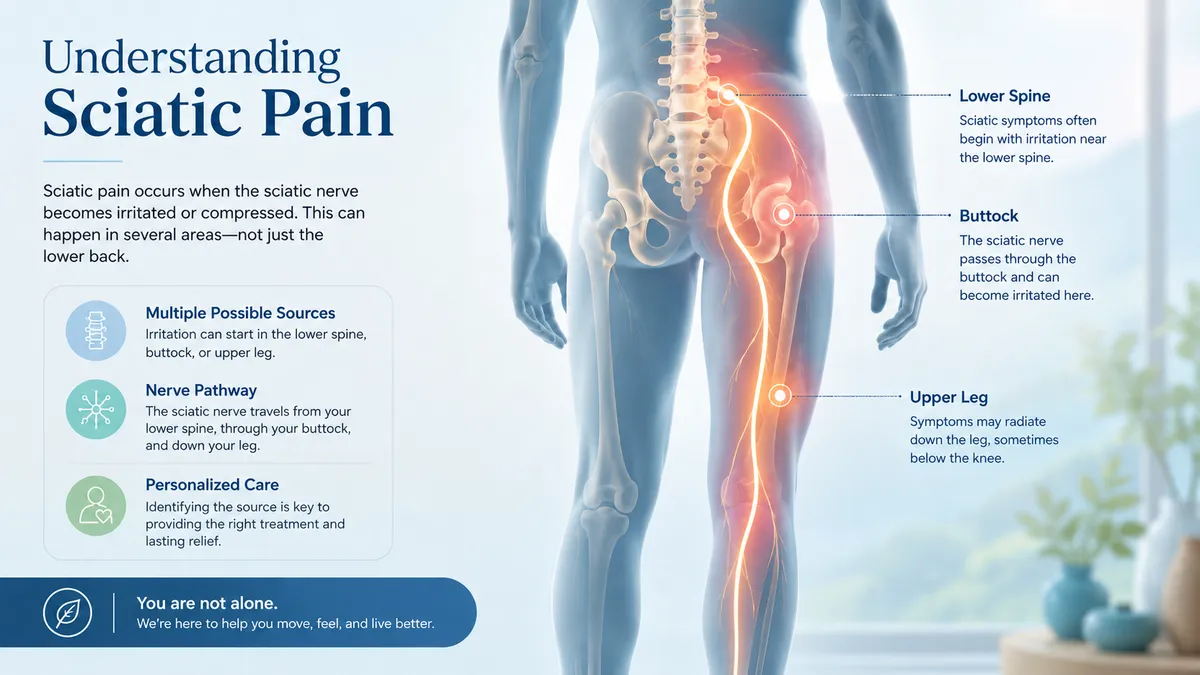
Sciatica is one of the most recognizable patterns of nerve pain, but it is not a diagnosis by itself. The term describes pain or other nerve symptoms that travel along the sciatic pathway—often from the buttock into the thigh, calf, or foot.
Many people assume every case begins with a disc in the lower back. Lumbar nerve-root irritation is common, but similar symptoms can also arise where the sciatic nerve passes through the pelvis or buttock. Hip, sacroiliac, and muscular problems can mimic sciatica as well. Identifying the source matters because treatments that help one cause may do little for another.
Why Sciatic Pain Can Start in Different Places
The sciatic nerve is formed by nerve roots from the lower spine. Those roots join in the pelvis, and the nerve continues through the buttock and down the back of the leg. Irritation anywhere along that route can create pain, tingling, numbness, or weakness farther away from the source.
A herniated disc may inflame or compress a lumbar nerve root. Spinal stenosis can narrow the space available for several roots, especially during standing or walking. Farther from the spine, muscles or fibrous tissue in the deep buttock can irritate the sciatic nerve. Less commonly, trauma, a mass, or another pelvic condition may affect the nerve.
This is why a patient can have intense leg pain with little back pain—and why the same word, “sciatica,” can describe several different clinical problems.
Clues That Help Separate the Causes
The pattern and triggers provide useful clues. Pain from a lumbar nerve root may worsen with coughing, sneezing, bending, or sitting. Spinal stenosis often causes heaviness or leg pain with standing and walking that improves when sitting or leaning forward. Deep buttock pain may worsen after prolonged sitting or with particular hip movements.
- Burning or electric pain down one leg
- Numbness or tingling in part of the leg or foot
- Weakness when lifting the foot, climbing steps, or pushing off
- Symptoms linked to sitting, walking, bending, or hip movement
These patterns guide the examination, but they do not replace it. Hip disease, vascular problems, peripheral neuropathy, and other conditions can resemble sciatica. New bowel or bladder problems, saddle-area numbness, or rapidly worsening weakness require urgent assessment.
How a Pain Specialist Confirms the Source
The evaluation includes strength, reflexes, sensation, gait, spinal movement, and hip or pelvic maneuvers. The clinician also reviews when symptoms began, how far they travel, and which positions improve or aggravate them.
MRI may be useful when symptoms persist, neurologic changes are present, or a procedure is being considered. Imaging must be interpreted alongside the examination because disc bulges and arthritis are common even in people without pain.
A targeted injection can sometimes help both diagnosis and treatment. For example, a lumbar epidural steroid injection may be considered when an inflamed spinal nerve root matches the symptom pattern. Symptoms thought to arise outside the spine may require a different target and different imaging guidance.
Matching Treatment to the Cause
Initial care often includes maintaining tolerable activity, physical therapy, and short-term strategies for inflammation or pain. Exercise should be adapted to the diagnosis; a program for a disc-related nerve problem may differ from one designed for spinal stenosis or a deep-gluteal condition.
When symptoms persist, options can include epidural injections, selective nerve blocks, or minimally invasive decompression for selected cases of stenosis. Chronic nerve pain that remains after appropriate treatment may lead to a discussion of peripheral nerve stimulation or spinal cord stimulation.
The goal is not simply to label leg pain as sciatica. It is to identify the responsible structure, protect neurologic function, and choose the least invasive treatment that reasonably supports walking, sleep, and daily activity.
Frequently Asked Questions
Can you have sciatica without back pain?
Yes. Leg or buttock symptoms can be much stronger than back pain, and irritation can occur outside the lumbar spine.
Does every case of sciatica need an MRI?
No. Imaging is usually guided by symptom duration, examination findings, warning signs, and whether an intervention is being considered.
How long should sciatica last before I seek care?
Seek evaluation when symptoms are severe, worsening, associated with numbness or weakness, or not improving after several weeks. Urgent warning signs should be assessed immediately.
Can an epidural injection help all sciatic pain?
No. Epidural treatment is aimed at inflamed spinal nerve roots and is less likely to help when the primary source is outside the spine.
Talk With a Pain Specialist
This article is for general education and cannot determine which treatment is appropriate for you. Oregon Pain & Spine can review your symptoms, history, and goals and explain reasonable next steps.
Pain Conditions
Explore Treatment Options Based On Your Pain Condition
Back Pain
Learn Moreabout Back Pain
Leg Pain
Learn Moreabout Leg Pain
Hip Pain
Learn Moreabout Hip Pain
Foot Pain
Learn Moreabout Foot Pain
Upper Limb & Neck
Learn Moreabout Upper Limb & Neck
Headaches & Migraines
Learn Moreabout Headaches & Migraines
Pelvic Pain
Learn Moreabout Pelvic Pain
Abdominal Pain
Learn Moreabout Abdominal Pain



I love Dr. Kemp, he is a compassionate doctor and listens to his patients. My only problem that I've had multiple times is getting my pain medicine called in before they run out. Today is another day that I've been trying to reach him for several days and all day long to get somebody to return my call me so I can get my opiate prescription refilled and nobody answers the phone nor has anybody called me back. I have had this problem in the past and it makes me believe that nobody understands what going through withdrawals is like. Just because I didn't get my prescription refilled I have to go through this. But Dr Kemp on a personal level is a really good doctor.
Very professional and friendly. Explains possible procedures with best options. He has teated both me and my husband with benificial long lasting results. We would highly recommend Dr Kemp as a Pain Specialist.
I really like Dr Kemp, he is the first doctor that has actually listened to my concern and I have been too many I would highly recommend him he is so nice and so is his nurse I look forward to having more appointments with him
I find the atmosphere to be very respectful. Inviting. And then I find Doctor kemp to be very detailed and understanding. And we go over the process that we need to do for the next appointment, I have a lot of anxiety and I think that Doctor Kemp and his nurses reassure me. Everything's going to be just 🙂 fine.
Dr. Kemp is very knowledgeable and is always in your corner. He makes you feel like you’ve known him for years and is easy to talk with. He will take the time to go over what options are available and does a great job of explaining them in detail. I feel very comfortable around him and his staff. I highly recommend Dr. Kemp to anyone suffering from chronic pain. One of the best out there!


Share This Story, Choose Your Platform!
- Share on Facebook (opens in a new tab)
- Share on X (opens in a new tab)
- Share on Reddit (opens in a new tab)
- Share on LinkedIn (opens in a new tab)
- Share on WhatsApp (opens in a new tab)
- Share on Tumblr (opens in a new tab)
- Share on Pinterest (opens in a new tab)
- Share on Vk (opens in a new tab)
- Share on Xing (opens in a new tab)
- Share on Email